LAX FREE OR DIE
RECRUITING · THE DEFINITIVE GUIDE
DON'T PANIC: WHAT FAMILIES NEED TO KNOW ABOUT THE NEW ERA OF COLLEGE LACROSSE RECRUITING
A guide for the Classes of 2027 through 2032 and the people who love them. What's actually confirmed, what's still unsettled, and what to do about it, class by class.
By Erin Chase · Last updated August 6th, 2026 · 18 min read
This is a living guide. I update it as the rules change. See the note at the end.
THE MOM
had read a Facebook thread.
THE DAD
had listened to a podcast.
THE PLAYER
had seen a TikTok.
Last week, three different recruiting families asked me essentially the same question:
"IS MY DAUGHTER SCREWED?"
All three were worried.
Here's the interesting part. None of them were worried about the same thing.
The mom thought roster limits meant her daughter's spot might disappear. The dad thought the new eligibility rules would push recruiting two years later. The player thought transfers were about to take every freshman spot in the country.
One of those concerns was mostly right. One was partly right. One was almost entirely wrong.
Not one of the three could have told you what the rule actually says.
That is not a criticism of them. It's a description of the moment we're in. A genuinely significant set of changes landed in college athletics over the last year, the details are technical, the coverage has been written mostly for football and basketball audiences, and into that gap rushed a whole lot of confident speculation.
SO TAKE A DEEP BREATH.
Some things really are changing. Several of them are big, and I'm not going to tell you otherwise. But a lot of what you're reading is guesswork written by people who benefit from you being scared. And the parts of this process that matter most, the parts your daughter actually controls, have not changed at all.
Let's separate fact from fiction.

START HERE: THE VOCABULARY
Four terms. Most of the confusion I hear comes from families blending these together, when they're actually four separate things that happened to arrive around the same time.
"5-FOR-5"
Often nicknamed “5-in-5,” although the NCAA says that name is not technically accurate. Division I athletes may now have up to five years of eligibility within one continuous five-year window. The amount of eligibility available depends on the athlete’s age and initial full-time college enrollment. This is an eligibility rule. It does not determine scholarships, roster limits, or recruiting contact dates.
AN ELIGIBILITY RULE
ROSTER LIMITS
come from a completely different place: the House settlement, the legal agreement that reshaped college sports money. Division I women's lacrosse programs that opted in are capped at 38 players. This is a roster rule.
A ROSTER RULE
TRANSFER PORTAL
is the system that lets athletes move between schools. It isn't new and it wasn't created by either of the above. What changed is who has a reason to use it.
A MOVEMENT SYSTEM
NIL
Is name, image, and likeness, meaning athletes can be paid for endorsements and, at some schools, share directly in revenue. It's largely separate from all of this, and for the overwhelming majority of lacrosse players, it barely registers.
A MONEY RULE
Four different things. They interact, which is what makes this confusing, but they are not the same thing, and conflating them is where most bad advice starts.
FIRST, THE RECEIPTS
What is genuinely settled, with dates, separated from what isn't. Most of the panic online comes from people mixing the two.
CONFIRMED
-
On June 23, 2026, NCAA Division I adopted an age-based eligibility model: five seasons of competition inside a five-year window, up from four seasons in five years.
-
The clock starts at initial full-time college enrollment, or the academic year immediately following the athlete's 19th birthday, whichever comes first.
-
Redshirting is gone. So are medical hardship waivers. The clock runs whether you play or not. Only pregnancy, active-duty military service, and an official religious mission pause it.
-
Full effect for anyone enrolling fall 2027 or later. Current athletes and fall 2026 enrollees may use whichever model benefits them.
-
D-I women's lacrosse programs that opted into the House settlement have a 38-player roster cap. Men's is 48.
-
Those same schools can award scholarships up to 38. The old cap was 12. Clemson has committed roughly $1 million a year to fully fund all 38.
-
Schools that opted out have no 38-player cap.
-
On August 5, 2026, NCAA Division II adopted the same age-based eligibility model, effective immediately for 2026-27. The clock, the exceptions, and the transition rules all mirror Division I. Division II did not adopt roster limits. The 38-player cap comes from the House settlement, which is Division I only.
NOT SETTLED
-
Updated August 6. Yesterday this section said the Division II vote was still pending. It is not. The executive board adopted the model on August 5. I told you to check dates on everything, including this article, and this is what that looks like in practice. One day.
-
Careful here: several recruiting websites still say D-II punted this to 2028. Those pages are out of date. A live example of why you should check dates on everything, including this article.
-
Division III has not adopted it at all. D-III remains on four seasons within 10 semesters of full-time enrollment.
-
Nobody knows how many players will actually use a fifth year. The single biggest unknown in this conversation, and every projection you read is a guess dressed up as a fact.
-
Nobody knows whether roster limits will be adjusted. As of today, no relief has been offered.
I'll flag my own opinions as opinions throughout. Where I don't know, I'll say I don't know.

01: WHAT HAS CHANGED
ELIGIBILITY
The old deal: four seasons of competition, five years to use them. That fifth year was your cushion, for a redshirt, an injury, or a slow start. The new deal: five seasons, five years, clock always running. There is no cushion anymore, because the cushion became a season. Think of it like a five-year gift card that starts spending itself the day it's activated, whether or not you use it. You can't put it in a drawer and save it.

CHECK WHETHER THE AGE-19 RULE MIGHT APPLY
This is the part being butchered online, so read this twice.
Your clock starts the academic year right after you turn 19, even if you're still in high school.
For a girl on a normal timeline, meaning she turns 18 during senior year, graduates in June, and enrolls that fall at 18, this rule does absolutely nothing to her. Her clock starts at enrollment, exactly like it always did. Full five years. No impact whatsoever.
Where it actually bites:
-
Reclassifying, meaning repeating a year. If your daughter is already 19 before her final year of high school begins, she is burning college eligibility while sitting in a high school classroom.
-
Post-grad years. Same math. A PG year taken after turning 19 costs a college season.
-
Any delayed enrollment past 19. A gap year, a late start. The clock doesn't wait.
Here is the clean test: Will she already be 19 before September 1 of her final year of high school?
As of August 5, 2026 this applies at both Division I and Division II. Division III is the only NCAA division where it does not.
If no, ignore all of this. If yes, sit down with someone who knows the rules before you make another decision.

ROSTER CONSTRUCTION
The 38-player cap is the real story for girls' lacrosse, and it's where it collides with the eligibility change.
Do the math with me. A 38-player roster spread across four classes is about 9 or 10 freshmen a year. Spread across five classes, it's 7 or 8.
That is roughly a 20% reduction in high school roster spots per year at capped Division I programs, if every player uses all five years. They won't. Hold that thought.
9-10
FRESHMAN / YEAR
OVER 4 CLASSES
7-8
FRESHMAN / YEAR
OVER 5 CLASSES
Roughly a 20% reduction in high school spots per year at capped D-I programs, if every player uses all five years. They won't. Hold that thought.

TRANSFERS
The portal isn't new. What's new is who has a reason to be in it. Every player who isn't getting minutes now has a fifth year available to go find them somewhere else.
"Every kid that doesn't play for you is going to be in the situation of being able to say, 'Well, if I can find somebody that wants me, I can play my fifth year.'"
KEVIN CORRIGAN
NOTRE DAME
Here's the part that gets lost. Portal players are mostly moving between programs, not adding to the total pool. When a junior transfers from School A to School B, School A now has an opening. The number of college lacrosse players in the country did not change. The distribution did.

COACHES' PLANNING
Coaches are now budgeting a roster across five classes instead of four, and doing it while already holding verbal commitments they made two years ago.
"If we were recruiting seniors, we might be able to budget for it. But given that we've got kids that have been committed for what will be two years, that could make things challenging."
KERSTIN KIMEL
DUKE
"A lot of it is still unknown. I think the unknown pieces are just how they're going to handle those roster limits that are in place."
CATHY REESE
MARYLAND
Read those again. Two of the best coaches in the sport are saying, on the record, we are figuring this out too. If they don't have it solved, the anonymous account in your comments section definitely doesn't.
SCHOLARSHIPS, AND THIS PART IS THE GOOD NEWS
Buried underneath all the panic: women's lacrosse scholarships went from a cap of 12 to as many as 38.
That is a real, meaningful expansion of money available to girls in this sport. It is the largest financial upgrade women's lacrosse has ever received, and almost nobody is posting about it, because "more scholarships available" doesn't generate the same engagement as "roster cuts."
The honest caveat: available is not the same as funded. Some schools are going all in. Many won't. The gap between programs will widen, and "Division I" will describe a much wider range of actual experiences than it used to. Ask specific questions about real funding. Don't assume the label tells you anything.

WHERE THE NIL FITS (MOSTLY, IT DOESN'T)
Families keep asking whether NIL changes their daughter's recruiting. For the overwhelming majority of girls' lacrosse players, the honest answer is no.
Schools can now share revenue directly with athletes, from a pool of roughly $20.5 million per school. But only about 5% of that pool reaches Olympic and non-revenue sports. Football and basketball consume nearly all of it. As Duke's coach put it, most programs don't expect their Olympic sports to be part of the revenue share at all.
Third-party NIL deals still exist, and Division I athletes generally have to report deals of $600 or more through a clearinghouse for review. Some lacrosse players do have real NIL income. It is not the norm, and it should not be a factor in your daughter's college choice.
If anyone tells you the new rules are "about NIL money" for lacrosse, they don't know this sport's economics.
THE CONTACT DATE DID NOT MOVE. THE CALENDAR AROUND IT DID.
There are two separate systems, and almost every recruiting website blends them.
System one is the contact date. It comes from NCAA legislation and it has not changed. Division I coaches may begin recruiting communication with a lacrosse player on September 1 of her junior year. Calls, texts, emails, direct messages. For the Class of 2028, that is September 1, 2026.
System two is the recruiting calendar. It is published by the NCAA every single year, it is different every single year, and it controls when coaches can see your daughter in person. This is the part that moves.
WHAT THIS MEANS FOR THE CLASS OF 2028
Here is where the two systems collide this fall.
August 28 through September 3, 2026 is a dead period.
So on September 1, when the phone is finally allowed to ring, Division I women's lacrosse is sitting inside a dead period that runs for three more days.
What that actually means:
Beginning at 12 p.m. Eastern on September 1, Division I coaches may call, text, email, or direct message members of the Class of 2028. There is no reason to stay awake until midnight or sit beside the phone all morning.
On September 1, a coach CANNOT meet her in person anywhere, watch her play off campus, or host her on campus for any kind of visit.
September 4 is the day that changes. That is when the contact period opens and in-person recruiting becomes permissible.
So if you have been told "September 1 is the day," that is half right. September 1 is the day the conversation can start. September 4 is the day anyone can show up.
ONE MORE DATE, AND IT IS THIS WEEK
August 1 through 14, 2026 is a recruiting shutdown.A shutdown is stricter than a dead period.
During a shutdown there is no recruiting of any kind, in either direction. No calls, no emails, no correspondence, nothing.
If your daughter emails a coach during those two weeks and hears nothing back, that is not disinterest. That is the rule. Do not let anyone in your family read silence in early August as an answer.

02: WHAT HAS NOT CHANGED
WHAT COACHES RECRUIT HAS NOT CHANGED EVEN SLIGHTLY
-
Talented players
-
Coachable players, arguably more than ever, since they're investing five years now
-
Good teammates
-
Strong students
-
Athletic players who can move
-
Players who fit their culture
Academics still open and close doors. With less roster margin they matter more, not less. A coach with 7 spots instead of 10 cannot afford an admissions risk.
Film still works. It's still the cheapest, highest-leverage thing your family owns.
Emailing coaches still works. Your daughter can reach out any time. September 1 limits when they can respond, not when she can write.
Division III did not change. Neither did the NAIA.
AND THE ONE THING THAT MATTERS MOST: THERE IS STILL NO SHORTCUT AROUND BECOMING A BETTER LACROSSE PLAYER.
Not one thing in the House settlement, the age-based eligibility model, or the transfer portal creates a workaround for a girl who can't finish with her left hand. No rule change has ever gotten anybody recruited. Development is still the whole game, and it is still the only part of this process your family fully controls.

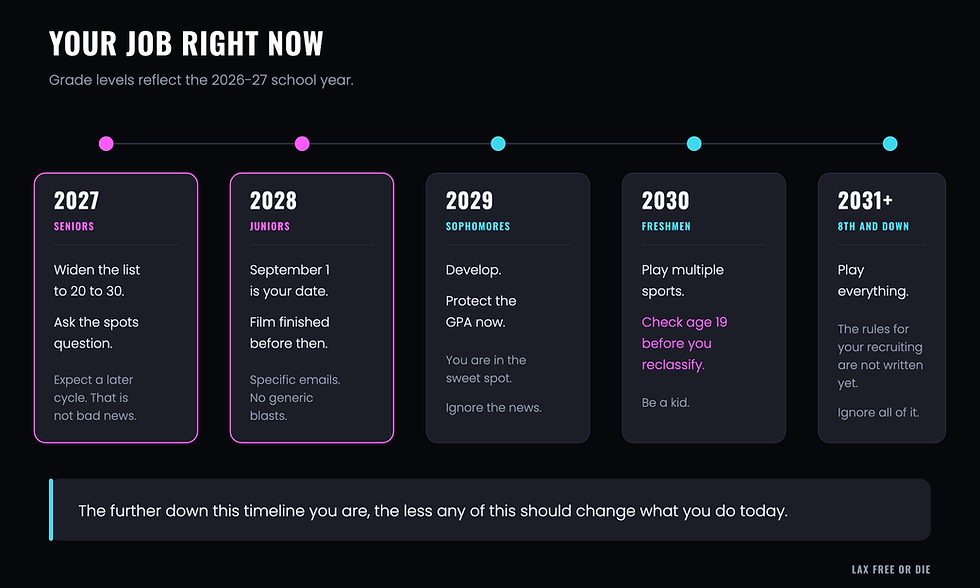
03: WHAT THIS MEANS FOR EACH CLASS
2027 | SENIORS
-
Widen your list to 20–30 realistic programs.
-
Ask coaches directly: “Do you expect to have a roster spot available for my position?”
-
Be open to Division II and Division III programs.
-
Expect decisions and opportunities to develop later than they did in previous recruiting cycles
-
Prioritize fit, opportunity and affordability over the biggest name.
2028 | JUNIORS
-
Division I communication opens at 12 p.m. Eastern on September 1.
-
Have your recruiting film, player profile, transcript and upcoming schedule ready before September.
-
Send specific emails that explain why each school interests you.
-
Expect calls, texts, emails and DMs beginning September 1.
-
Remember that September 1–3 is a dead period. In-person contact and recruiting visits can begin September 4.
-
Do not mistake silence on September 1 for a final answer.
2029 | SOPHOMORES
-
Develop your game instead of chasing recruiting attention.
-
Protect your GPA and begin learning what type of college might fit you.
-
Build good training, communication and film habits now.
-
Play multiple sports if they help you develop and you enjoy them.
-
Do not let another class’s recruiting timeline rush yours.
2030 | FRESHMEN
-
Play, develop and enjoy being a high school athlete.
-
Build athleticism, stick skills, confidence and good academic habits.
-
Continue playing other sports.
-
Before reclassifying, taking a gap year or delaying college enrollment, understand how the NCAA age-19 trigger could affect eligibility.
-
You do not need to specialize or attend every recruiting event.
2031 AND YOUNGER
-
Play everything.
-
Learn how to compete, communicate and be a great teammate.
-
Choose environments with strong coaching and development
-
Ignore recruiting pressure.
-
The rules may change before your process begins.
-
There is no recruiting emergency. Let kids be kids.
-
YOUR JOB CHANGES BY CLASS.YOUR JOB IS NEVER TO PANIC.
04: WHAT COLLEGE COACHES ARE PROBABLY THINKING
I can't read minds and I won't pretend to. But based on what coaches are saying publicly, here's what's realistically on the whiteboard.
"HOW MANY SPOTS DO I ACTUALLY HAVE?"
They may genuinely not know yet. A coach who tells you "I'm not sure" is being honest, not dodging you.
"HOW MANY OF MY PLAYERS WILL ACTUALLY PLAY A FIFTH YEAR?"
Nobody knows. Duke's John Danowski raised the flip side that everybody forgets:
"There's a lot of young men and women that four years, and they've had enough of college, they're ready for the real world."
JOHN DANOWSKI
DUKE
That's the sentence I'd underline. The doomsday math assumes every athlete takes year five. Real people don't behave that way. Some will want to graduate, start careers, and move on with their lives.
"DO I RECRUIT HIGH SCHOOL PLAYERS OR THE PORTAL?"
Both, but the balance is shifting, and different programs will answer this differently. Boston University's Ryan Polley sees opportunity in not chasing transfers:
"There's an opportunity if your program can be known as one that's not going to dive heavy into the transfer market, you're going to recruit your kids, you're going to develop them."
RYAN POLLEY
BOSTON UNIVERSITY
Find those programs. They exist, and they're better fits for most players anyway.
"CAN I STILL TAKE A PROJECT?"
This is the hard one, and I want to be honest that it's a real cost. Developmental recruiting gets riskier when every spot has to produce. Danowski's worry is that a freshman who used to wait one year for playing time might now wait two.
"DO I NEED MORE FLEXIBILITY IN HOW I COMMIT?"
Reese flagged the commitment side: if you sign a player for five years, you're locked in and obligated to that. Expect more careful, more conditional conversations.
AND THIS IS THE ONE THEY ARE ALL THINKING
"IS THIS KID WORTH FIVE YEARS OF MY ROSTER?"
That question is not a threat. It's an opportunity, and it's the most useful thing in this entire guide. It means character, coachability, academics, and fit just became more valuable relative to raw ranking, because a coach is now making a five-year bet on a person, not a four-year bet on an athlete.
If your daughter is a great teammate who works hard, her value just went up.
05: WHAT PARENTS SHOULD STOP DOING
STOP PANIC EMAILING COACHES
A "just checking in given all the rule changes??" email in July/August tells a coach your family is anxious. Coaches are looking for athletes and families who can navigate uncertainty with maturity, communicate clearly and contribute positively to a program.
STOP ASSUMING RECRUITING IS OVER
Girls in the Class of 2027 are being actively recruited right now, today. This cycle is running later, not shorter.
STOP COMPARING YOUR DAUGHTER TO COMMITMENT POSTS
You're seeing the highlight of somebody else's process with none of the context: not the fit, not the money, not whether she'll still be there in two years. Comparison has never once made anybody a better lacrosse player.
STOP CHASING EVERY SHOWCASE
This costs real money, and the new math makes over-exposure worse, not better. If coaches take 7 recruits instead of 10, being seen ten more times doesn't help. Being seen once, playing well, by the right eight coaches does. Pick fewer events, prepare properly, and tell coaches in advance you'll be there.
STOP TREATING "D-1" AS THE GOAL
With scholarship funding now varying enormously between programs, that label tells you less about the actual experience than it ever has. A fully funded mid-major and a barely funded one are both "Division I," and they are not remotely the same opportunity.
06: WHAT PARENTS SHOULD DO
FUND DEVELOPMENT, NOT EXPOSURE
If you're going to spend money, spend it on getting better. A season of skill work beats a fourth showcase. The highest-return decision available to your family, and more true now than a year ago.
PROTECT THE GPA
Fewer spots means less tolerance for admissions risk. Grades are recruiting currency.
MAKE FILM COACHES WILL ACTUALLY WATCH
Recent. Short. Best clips first. Full-field context so they can see what she saw. Jersey visible. You do not need a production company. You need good clips, well organized.
BUILD RELATIONSHIPS, PLURAL
Not one dream school. Twenty programs across three division levels, honestly researched. That isn't settling. That's how people find the place that's actually right for them.
LET HER DRIVE
She writes the emails. She talks on the calls. Coaches notice, and in a five-year-commitment world they are screening hard for maturity.
ASK DIRECT QUESTIONS AND WRITE THE ANSWERS DOWN
How many recruits in my class? Has that number changed? How are you funding scholarships? What percentage of your roster finishes all four years? That last question tells you more about a program's culture than anything on its website.
BE PATIENT ON PURPOSE
Later timelines mean waiting is now correct behavior, not falling behind.
CHECK IF THE AGE-19 RULE IF IT MIGHT NOT APPLY
Reclassifying, a PG year, a late birthday, delayed enrollment. Five minutes of checking now prevents losing a year later.
07: WHAT LFOD IS WATCHING
I don't know how all of this settles. Anybody who claims they do is guessing. But I know which questions will determine the answer, and I'm tracking them. Here's what I'm watching over the next 12 to 24 months, and, more importantly, what would actually change my advice.
1. WILL RECRUITING TIMELINES MOVE LATER, AND BY HOW MUCH?
When 2028 and 2029 commitments actually happen compared with prior classes.
WATCHING FOR
WOULD CHANGE MY ADVICE IF TIMELINES MOVE EARLIER
Timelines move earlier instead, suggesting coaches are locking in high school recruits to protect against portal chaos. I don't expect that, but I'd rather be watching than assume.
2. WILL ROSTER LIMITS CHANGE?
Any NCAA move to raise or phase the 38-player cap, and how many schools quietly opt out of the settlement.
WATCHING FOR
Caps rise or relief is granted, in which case the squeeze I'm currently projecting mostly evaporates.
3. HOW MANY ATHLETES WILL ACTUALLY USE A FIFTH YEAR?
Real roster data after the 2026-27 and 2027-28 seasons. This is the number that determines whether the "20% fewer spots" projection is real or theoretical.
WATCHING FOR
Fifth-year usage comes in low, under maybe 20% of eligible players. Then most of the current panic was never warranted, and I'll say so loudly.
4. WILL DIVISION III FOLLOW?
Division II adopted the model on August 5, 2026. Division III has not, and remains on four seasons within 10 semesters. Watching for any signal from D-III governance.
WATCHING FOR
Would change my advice if: DIII moves? It is now the only NCAA division where a reclassification or PG year does not cost eligibility, which makes it the stability play in this sport, and that recommendation depends entirely on D-III staying put.
5. HOW WILL THE TRANSFER PORTAL AFFECT FRESHMAN PLAYING TIME?
Whether freshmen at capped programs actually see the field, or whether experienced transfers push them to the bench.
WATCHING FOR
Freshman minutes collapse. That would strengthen the case for choosing a program where she'll play immediately over a bigger name where she'll wait.
6. WILL COACHES BECOME MORE SELECTIVE, OR JUST MORE PATIENT?
Whether offers get harder to earn, or simply arrive later in the cycle. Those look identical from a family's side in year one and are completely different in year three.
WATCHING FOR
It's genuine selectivity rather than patience, which would mean list-building matters even more than I'm currently telling families.
7. COULD THIS QUIETLY HELP MULTI-SPORT ATHLETES?
Any sign that coaches evaluating five-year fits start valuing athleticism and upside over early specialization and tournament mileage.
WATCHING FOR
This is the one I'm rooting for. If coaches are making longer bets, the athlete still ascending at 17 becomes more valuable than the one who peaked at 15. I have no evidence yet. I'm watching closely, and I will report honestly either way.

MY PERSPECTIVE
I want to be honest with you about where I actually land on all of this.
I THINK THIS COULD TURN OUT TO BE A GOOD THING.
Not because the transition won't be messy. It will be, and the Class of 2027 is going to feel it. But because the recruiting process we've built over the last fifteen years has been broken in ways that everybody acknowledges and nobody fixes.
It got too fast. We've had fourteen-year-olds making decisions about who they would be at twenty-two.
It got too expensive. Families are spending thousands of dollars a year chasing exposure, and I have watched that money buy anxiety instead of opportunity.
It got too everywhere. Kids feel like they have to be at every event, on every team, in front of every coach, every weekend of every season. And then we all sit around saying we wish we had more multi-sport athletes. We built the machine that eliminated them.
So here's what I'm hoping for.
I hope that when a coach has seven spots instead of ten, she slows down. I hope she watches longer, asks more questions, and cares more about who the kid actually is. I hope "she's a great teammate and she works" starts to count for more than a ranking, because a coach making a five-year bet has every reason to care about that.
I hope development gets rewarded over exposure. I hope the girl who couldn't afford the national club circuit, but who got demonstrably better every single year, finally has that count for something.
I hope coaches end up with better tools to find athletes who genuinely fit their programs, instead of athletes who happened to be standing on the right field on the right Saturday.
I don't know if it will play out that way. I genuinely don't. Anybody who tells you they know exactly how recruiting will look in three years is selling something.
But I know this much:
THE ATHLETE WHO KEEPS IMPROVING, COMMUNICATES WELL, WORKS HARD, AND FINDS THE RIGHT FIT WILL ALWAYS HAVE OPPORTUNITIES.
That was true before June 23rd. It's true today. It will be true when whatever comes next comes next.
Take a breath. Go get better. That's the plan, and it always was.
Erin
ONE LAST THING
This landscape is going to keep moving. Some of what I've written here will look different in a year, and a few things will probably turn out to be wrong.
So I'm not treating this as an article I published once.
I'M TREATING IT AS A GUIDE I MAINTAIN.
I will keep updating this page as the recruiting landscape evolves, with the date changed at the top and a note about what's different, so LFOD families always have the most current and most honest information available. When something in the "What LFOD Is Watching" section resolves, I'll move it into the confirmed facts and tell you what it means for your daughter.
Bookmark it. Share it with the family in your club who's panicking. Come back to it when something changes.
That's what it's for.
WANT CLEAR RECRUITING UPDATES WITHOUT ALL THE PANIC?
Join the LFOD recruiting email list for important rule changes, recruiting deadlines and honest advice about what your daughter should actually be doing next.No noise. No pressure to attend everything. Just practical guidance that helps your family make smarter recruiting decisions.
Need more individualized support?
I work with a limited number of athletes in each class to build realistic school lists, improve coach communication, organize recruiting film and create a plan that fits the athlete, not the recruiting noise.
STILL HAVE A QUESTION?
Reply to the newsletter and ask. I read every one, and the good ones become the next update to this guide. Not on the list yet? Get the free Draw Training Guide and Confidence Playbook while you're here.